DNC Rules Committe Live Stream
(Update) Members Returning For Evening Session
**update** 5.37pm Rumor has it that the reason the Rules Committee is not back yet is that they are meeting in private (closed session) to decide how to handle this situation.
**update** 6.15pm DNC Rules & Bylaw Committee about to start up again.
Podcast Appalachia: "Appalachian Abolitionism"
Listen to it here. I am sorry, but I don't believe the service he uses allows other sites to embed the player, so you'll have to leave the website to listen.
Transcript
Appalachian Scribe
MAMA Sighting
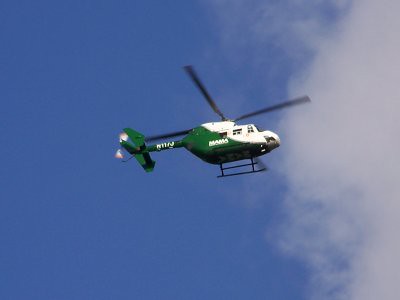
My house lies under the flight path the the MAMA (Mountain Area Medical Airlift) Helicopters use to travel between Franklin, NC and Asheville, NC.
I was setting up to capture a time-lapse sequence of clouds when the helicopter flew overhead.
ASHEVILLE CITY COUNCIL REPORT – MAY 27
Or, you can watch it here, or on the player below:
NC House Wants To Give Teachers 3 Percent Raise
Judge Keeps Freaks Off North Carolina Ballot
RALEIGH - A judge has upheld North Carolina's high standard requiring tens of thousands of signatures to be collected before a group is officially recognized as a political party. He ruled that no fundamental right exists for the party of a voter's choice to be on the ballot.The Libertarian Party sued the state in 2005, arguing that requirements to get on the ballot and stay on it are too onerous, violating party members' rights to freedom of speech and association. The Green Party of North Carolina later joined the lawsuit.
Source: Raleigh News & Observer
Related: Read the Decision on WikiLeaks Dime [warning pdf file]
Too onerous? 70,000 signatures? Apparently the LPs and the Greens need a marketing strategy, instead of a legal strategy. They already have whining down to a fine art...
It gets better:
Just when you think North Carolina governance cannot sink any lower….Superior Court Judge Robert Hobgood sided with the state and upheld restrictions on recognizing parties not Republicrat. In other words, adding more than two choices to the ballot would burden the state and confuse voters.
“The more parties there are that are recognized by the State and that place candidates on the ballot, the greater the chance there is for ballots that are so long as to be unwieldy and to risk voter confusion and frustration of the electoral process,” Judge Hobgood’s opinion claims.
Source: Jeff Taylor, in the Meck Deck outlet of the John Locke Foundation.
Archive Link in case the original "disappears".
But wait, there's more:
North Carolina has one of the most restrictive ballot access laws in the nation. Currently, third parties must collect more than 67,000 valid signatures to be listed on the ballot. That is the equivalent to 2 percent of the number of voters in the last gubernatorial election. The Libertarian Party successfully collected about 79,000 valid signatures to be on the fall ballot, but the effort took four years and cost nearly $140,000.
The Green Party has never appeared on the North Carolina ballot.
Source: Indy Week
If it took the Libertarians $140,000 and four years to gather 79,000 signatures, I can say nothing more to add to, or subtract from their status as a movement. The Greens are even worse, never having achieved even that much.
What we have here is a bunch of whiny pot-smoking kids (and graying hippies) who are too stupid to build their own political movement, and too stupid to even take over another political party.Nesbitt Ethics Problems Surface Again
RALEIGH --A state senator from Asheville, his son's Hooter's Pro Cup racing team and Blue Cross Blue Shield of North Carolina are at the center of a dispute over who has the right to police the state ethics laws.
The case surrounding Sen. Martin Nesbitt, an Asheville Democrat, has led to a bill that would prohibit the state auditor from investigating the recently overhauled ethics statutes.
“The Nesbitt case illustrates the danger of the misapplication of a complicated law,” said Perry Newson, executive director of the state ethics commission.
Nesbitt waived confidentiality and allowed Newson to discuss the case.
State Auditor Les Merritt, a Republican, released a report Tuesday in which he explains why he believes Nesbitt should have disclosed on ethics filings that he worked with his son's racing team. Nesbitt was an unpaid crew chief.
Merritt's report came several months after the state ethics commission advised Nesbitt he did not need to disclose his involvement with the racing team on his ethics form, an opinion they reiterated after Merritt began his probe.
Until recently, the team was sponsored by Blue Cross Blue Shield, the state's largest insurer. The General Assembly frequently deals with legislation affecting the health care industry and insurers.
Source: Charlotte Observer
Related: State Auditor Report [PDF File]
Commentary
I would like to point out that the North Carolina State Ethics Commission was created in the wake of corruption scandals involving many elected and appointed state officials, most notably the NC Speaker of the House Jim Black, is composed of members appointed by the Gov. Mike Easley (Democrat), Speaker Joe Hackney (Democrat) and President Pro Tempore Marc Basnight (Democrat).
There is a turf battle ongoing to decide who investigates ethics violations, members appointed by the ruling political party, or the elected state auditor.
We have seen the results of the Governor and his friends in Raleigh who have blocked every attempt at investigating corruption in North Carolina government, with a breakthrough only achieved by the Feds, then the state charges followed.
Just as with Jim Black, there were whispers of misdeeds for years...and the state would not act. The same allegations have floated around about Martin Nesbitt for years also. And now Blue Cross Blue Shield has withdrawn their sponsorship of the racing team that was at the center of the controversy.
Previously:
North Carolina Conservative Disavows Indictment
BREAKING-- NC Senator Nesbitt To Be Indicted?
More on Corruption in North Carolina Politics
Letter From HK Edgerton:
An Open Report/ Confederate Memorial Day
Memorial is defined by Webster as something serving to preserve or keep remembrance alive. Confederate is define by Webster as an alliance or uniting. The month of April in the Southland of America marks the observance of Confederate Heritage, and soon after in the month of May celebrations of Confederate Memorial Day began. These two months mark a period when the honorable people of the South came together to defend their homeland from an unconstitutional invasion steer headed by a President who would be later martyred by the victors who would write the history of the events that led up to his death instead of the actual crimes that he and the men whom he commanded committed against the Southern people. It was the perspicacity( acuteness of mental vision or discernment)of Southern women that led to these celebrations. Having witnessed the success of the scandalmonger Harriet Beecher Stowe’s novel; they knew that the true history of the Southern people, the causes that warranted their actions would be forever tainted if left to the northern revisionist historians or northern academicians sent to the South to teach in the newly established public school system instituted by the federal government with the expressed charge of inculcating into the thinking processes of a nation the evils and rebellious nature of the Southern people and its own virtuosity.
On February 18, 1861, the Honorable President Jefferson Davis would give his Inaugural Address on the then Capitol steps of Montgomery, Alabama. Some 87 years later in city of Asheville, North Carolina, on February 18, 1948, I would be born to the Honorable Reverend Roland and Anna Belle Edgerton. Never in my wildest imagination would I ever have believe that as the son of former slaves that I would be given the honor not once but on several occasions ; to give the keynote speech in memory of the Confederate soldier and those who looked like me who were his family and friends and who stood by his side.
It would began for me on April 26, 2008 in the city of Ringgold, Georgia where the day before the Honorable Roger McCredie and the Honorable Kirk D. Lyons of the Southern Legal Resource Center would process a law suit against the City of Ringgold for the desecration of the Confederate Memorial at the Depot there. I would arrive in Ringgold at 8:30 AM, position myself at the front entrance of the Depot, brandishing the Southern Cross, and be joined by Pop and other Southern Compatriots later who had come to hear me deliver the keynote speech at a planned rally at the Ringgold courthouse at noon. It was reported to me that more Africans had lived in this very county and that more of them had gone off to war in support of the Southland than any other county in Georgia. I was somewhat baffled that those who remained here and were descendants of those honorable Africans would stand idly by and watch as the honor of their ancestors would be placed asunder by a few. Yet I would also learn that it was Southerners who sat on this very Council with the exception of just two who would lead this unholy charge against the Southern Cross. General Patrick Ronayne Cleburne, for sure would have been disappointed at the actions of the descendants of the Africans who he had praised and put his reputation on the line for when he asked in a circular letter to President Davis , and his peers , that the Africans be brought into the Confederate ranks legally. Now they used his flag against the Confederate soldiers and the Southland that he and their ancestors loved so dearly. I would leave Ringgold and travel back two hours down Interstate 75 where I would attend the Tennessee Sons of Confederate Veterans State Re-union. After listening to a great keynote speech and having been treated like royalty by State Commander Dr. Bradley, Commander Ron Jones, past commander Ed Butler, past Commander Skip Earle, the ladies of the Tennessee Order of the Confederate Rose and their new President Ms. Jan Hensley and the many guest gathered, I would speak briefly, receive a rousing ovation that brought me near tears, and began the 6 hour drive to Marion, Alabama.
Sunday morning April, 27, 2008 I would deliver the first of two speeches for Confederate Memorial Day in the City of Marion Alabama. The first I would deliver on the grounds of the Episcopal Church, the Church of the Honorable Robert E. Lee, but not before being told by the Sons of Confederate Veterans Commander, the Honorable Gary Johnson that the Episcopalians had forewarned the Sons that no Confederate flag could be brought to the area of the cemetery so named Confederate Rest where the many Confederate soldiers lie in their final resting place. Two empty flag poles stood in the center of the grounds over the soldiers graves where the 1st national and Alabama secession flag had already been removed in dishonor. Commander Johnson would tell the many gathered that I was not a member of the Sons Camp there in Marion; therefore he could not admonish me for defying the request of the Episcopalians. I stood ready with the Battle Flag and delivered the keynote speech, and anxiously awaited any action the Episcopalians might bring. Here I stood on the grounds where the Bishop of the Episcopalian Churches of Alabama was also the President of the School of the South, a school so designated in its conception was to fight the very things that it now so willingly adheres to ; dishonoring the memory of the Confederate soldier and the people who united together to fight a man who had invaded their homeland and the constitutionality of their right to sovereign governance. After delivering the keynote speech, alongside the many Sons and ladies of the United daughters of the Confederacy and members of the public , we would leave Confederate Rest in a parade formation and march the some 3 miles through downtown Marion to Elmwood cemetery where once again I would deliver the keynote speech.
On Friday May 2, 2008, I would arrive in Columbia, South Carolina where I would join the ladies of the Order of the Confederate Rose, the Sons of Confederate Veterans and others in the reading of the Muster Role of the Confederate soldiers. On Saturday morning after gathering in Elmwood cemetery and listening to a rousing speech by Rev.Bob Slimp and others, we would all march back to the State House Capitol grounds where I, the Son of former slaves in the State of my mother would be given once again the great honor of delivering the keynote speech for Confederate Memorial Day. I know that she and my father looked down on this day with great pride as once again I would receive a rousing ovation from those who had gathered to listen.
On Monday, May 26, 2008, I would once again adorn the uniform of the Southern soldier and pick up the Southern Cross. I would station myself at the Zebulon Vance and General Robert E. Lee monuments as I awaited the Memorial Day Ceremony that was to take place in two hours. I would pose for many pictures and answer many questions from the many citizens and visitor who would stop and was so impressed by the young black woman who stopped with her husband and young daughter who not only wanted to take pictures, but wanted her child to understand the honorable role that black folks had played alongside their Southern White family in the War for Southern independence. I had earlier been joined by Rocky D., a prominent Radio talk show host from Charleston, South Carolina and his lady friend Becky. Rocky would comment on the many pictures I would take and the warm reception I was receiving. He and Becky would soon leave to visit the North Carolina Arboretum and tell me that they would return for the Veterans Day Ceremony at City County Plaza. Upon arriving at the Plaza, I would be warmly greeted by many who had gathered, take pictures with the Boy Scouts, the gentleman whose picture who appear on the front page of the Mountain section of the local newspaper that reported on the activities of the day, chide a woman from the North who asked of me how I could appear in a Confederate uniform carrying a Confederate flag. I told her that it was the actions of a Southern woman(MS. Nora Fontaine Davidson) that had spearheaded this event, and that furthermore Americans should never forget the Southern soldier. I received a thunderous ovation from the many other ladies who were listening to the conversation. Soon I would be greeted warmly by the Honorable Bob Caldwell, a local TV news celebrity who present the Welcome and Closing comments for the days program and the local Commander of the Veterans of Foreign Wars. They would both express their gratitude in my presence. Mr. Caldwell would began his opening comments by talking about how Union General Logan, First Commander of the Grand Army of the Republic after being influenced by his wife upon her visits to Blanford Cemetery had recommended a National Decoration Day. “National Memorial Day.” Chaplain Candidate (2LT) Shumpert was called upon to deliver the Closing Comments after Guest Speaker Congressman Heath Shuler gave the keynote, and I must say that I was somewhat surprise to hear Sgt. Joshua Peyton O’Connor and Major Michelle Bretz read a letter from a Confederate soldier. Chaplain Candidate (2Lt) Shumpert just couldn’t leave well enough along. He came to the podium with everyone including myself expecting him to deliver the Benediction. I removed my cap, and the officer began his comments by saying that he wanted to continue the dialogue that Mr. Caldwell had started about Union general Logan. He started talking about the generals comments on the recent unpleasantness committed by the rebellious Southerners and how the efforts of the union soldier would never allow such a rebellion to happen again. On and on he went sticking it to the South, until I replaced my hat upon my head, took four steps backward and placed my flag at half staff. After Mr. Caldwell finished the closing remarks, I went directly to the stage where Chaplain Candidate(2LT) was seat and told him in no uncertain terms that I did not appreciate his comments. With a dumb look on his face, he asked another soldier and others seated on the stage, what did I say ? Mr. Caldwell must have understood my rage for he would approach me moments later and once again comment on how much he appreciated seeing me there.
Rocky D and his friend would existed from the audience soon after and ask of me if Mr. Shuler was the Mayor ? I pointed to Ms. Bellamy and asked if they wanted to meet her ? They both said yes. I approached the Mayor who was in a conversation with a member of the Statehouse. After some time I begged her apology to get her attention. Very gruffly, she said just a moment and turned her back on us. We stood patiently for several minutes waiting for the mayor to finish her conversation with the lady. Finally she turned to her left with her back still to us and asked a group of Boy Scouts and young ladies had on what appeared to be Boy Scout shirts if they wanted to attend a City Council meeting and recite the Pledge of Allegiance to the Flag, and gave them a number to call to do so. The Scouts looked somewhat dumbfounded by the dialogue because they had not even solicited the request. She then turn around and I introduced Rocky D and his friend. Rocky began a conversation about the Mayor of Charleston, and Mary a photographer who had been taking pictures asked the mayor if she would take a picture with me. Ms Bellamy’s reply was no, I’m not going to take a picture with him. Everyone gathered seem somewhat surprised by the Mayors response and the way she responded to Mary whose father had been a veteran in WWI and had fought in many famous battles. Mary like many people gathered who have followed my exploits with the Confederate cause knew that I had posed with many Mayors, Senators, Governors, and a host of celebrities all across this nation taking pictures with the Southern Cross adorned in the uniform of the Southern soldier , and had even posed with the young scouts who now looked somewhat more perplexed by the actions of the Mayor. All in all it had been a great day in Dixie, but I don’t think that I shall ever again attend the Asheville –Buncombe Memorial Day Ceremony.
Bob Pittenger Resigns To Focus On Race For Lt Governor
I think that it should be a law that in order for anyone who is already serving in an elected office must resign from their office if they are campaigning for another office.
Tax Credits for Children with Special Needs
This is a wonderful bill that helps parents of children with special needs take control and participate in their child's education
WAKE COUNTY NC NEWS -- House Bill 388 "Tax Credits for Children with Special Needs," allows an individual income tax credit for part of the expense of each eligible child with special needs who is educated in a nonpublic school or in a public school where tuition is charged for the student's enrollment. The education expenses' credit is equal to the amount paid for tuition and other educational and therapeutic expenses, not to exceed $3,000 per semester. House Bill 388 is expected to have its second reading in the North Carolina House of Representatives this general assembly 2008 session. This is a wonderful bill that helps parents of children with special needs take control and participate in their child's education, by allowing them to choose the most appropriate school for their child's education. Furthermore, House Bill 388 has bipartisan support, and is sponsored by NC House Representatives:- Representative Rick Glazier (Dem) of Cumberland County
- Representative Marvin W. Lucas (Dem) of Cumberland County
- Representative Paul Stam (Rep), of Wake County
- Representative Laura I. Wiley (Rep), of Guilford County
Tax Credits for Children with Special Needs (HB 388)
Parents of special needs children are examining their educational options and are finding out that they have very few। All families, like the Petruk family in Charlotte, want their child to receive an appropriate and meaningful education। What the public classroom is able to offer may be less than the "best opportunity" for success. Their son's placement in a classroom with 23 other special needs children leaves little time for the one on one instructional and physical environment needs that are necessary for his specialized learning requirements. This problem is in no way unique to the Petruk family. It is a sobering fact for many of our families that have children with exceptional learning needs. It is even more disheartening for these families to know there are non-public educational opportunities and services that are structured specifically for their child's particular disability but they are unable to enroll their child because of financial limitations. The price is simply too high...Read entire House Bill 388
North Carolina Republican House Leader, Paul "Skip" Stam is an emotional stirring writer as well as an accomplished speaker. On May 13, 2008, At the opening of this year's General Assembly 2008 regular session, Representative Stam gave an introductory speech to the NC House of Representatives introducing Senate Republican Leader Phil Berger and GOP nominee for Governor, Mayor Pat McCrory, to the floor, this amazing speech which was only skimmed over by main stream media. Go House Bill 388! Finally, we would like your opinion about this Bill. Please take time to analyze and discuss this bill on this Blog.
Old Glory Radio Live Video Show
Don't forget to click the button to play at 9pm.
Kay Hagan To Raise Money In California
I have friends out in California who will be watching this for me, and if any of you have additional details, get in contact with me in the comments.
Freedom Works Visits Congressman Shuler's Office
Local video producer, and co-host of Sound Off Buncombe (check URTV for air times) was also there to record the event.
Bill Lack gives an explanation of what Freedom Works is about at the end of this 10 minute preview of a 30 minute program to air in June.
Don Yelton on Sound Off Buncombe
Richard Bernier, of URTV's Sound Off Buncombe (Charter Channel 20), sat down with Don Yelton for an hour, and here is the video. It will be airing later in Buncombe and Madison Counties.
Tracy Bridges Expose on Spring Creek News
It has been my experience that where you find gambling, there you will find corruption. Local, State, Tribal, Federal...follow the money.
Hat Tip: Don
Nikwasi Celebration Slide Shows
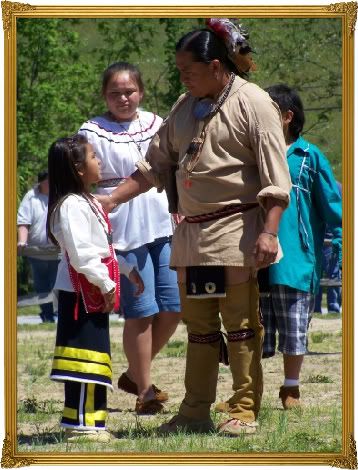
I have posted a couple of Slide Shows from photos I took Saturday at the Nikwasi Celebration over at Thunder Pig.
Dedication of Cherokee Heritage Trail Marker
Gordon Mercer, of the Public Policy Institute, was the Master of Ceremonies and Cherokee Chief Michell Hicks the Featured Speaker.
There were more speakers, songs, dances, craft demonstrations, Cherokee food, and a stickball exhibition game that was quite intense.
I have a lot of video to edit my way through, and since I lost my MP3 player, my options are limited, as I was using it to catch audio when I had to change memory cards in my camera and when I changed batteries. I plan on having an hour and a half to two hour show out of it by Tuesday afternoon.
Here is what is inscribed on the main marker beside the mound:
NIKWASI MOUND
You are standing on land that has been part of a town for about three thousand years. This mound was the spiritual, political, and physical center of the Cherokee town of Nikwasi. A council house or town house on top of the mound held the sacred fire, and everyone gathered there to hear news, make decisions, dance, and participate in ceremonies. Surrounding the mound were about one hundred houses, a field for playing stickball, and a dance ground, as well as hundreds of acres of crops, orhards, and gardens.
The Cherokee dominated the southern Appalachians for thousands of years. When Alexander Cuming visited Nikwasi in 1730, the Cherokees had men and women leaders in autonomous towns that functioned democratically. Cuming called a council here that was attended by more than two thousand representatives from Cherokee towns. Cuming chose an Emperor, and took a Cherokee delegation to London. In 1761 the British, former allies of the Cherokee, destroyed Nikwasi. After theCherokees rebuilt, the Americans destroyed it in 1776. The Cherokees rebuilt again and lived here until this area was taken by the Treaty of 1819.
A Cherokee legend tells that spirit warriors came out of the mound to help defend the Cherokee against an attack when the Cherokee men were away hunting. The legend goes on to say thst the spirit warriors also saved the town of Franklin from destruction during the Civil War.
The Nikwasi mound is one of the largest surviving mounds in the original Cherokee territory of 140,000 square miles. In 1946, the schoolchildren of Macon County saved their pennies and bought the mound through the Macon County Historical Society to save it from development. It is now owned by the Town of Franklin.
And here are some pictures to look at until tomorrow:
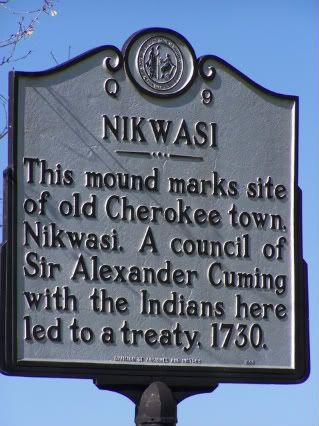
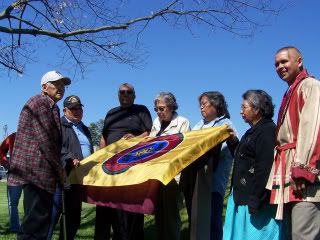
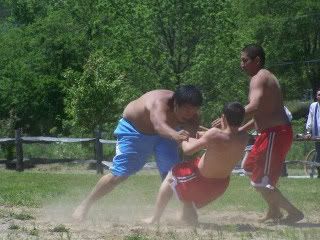
NIkasi Celebration in Franklin Today
The Nikwasi Celebration, a community event of cultural exchange to recognize the inclusion of the Nikwasi Mound on the Cherokee Heritage Trails, will be held this Saturday, May 17, at the Big Bear Park in Franklin.Source: Macon NewsThe Nikwasi Mound, located in downtown Franklin, is one of the best-preserved ancient Native American mounds in the country. Long ago, Franklin was the village of Nikwasi, and the village townhouse sat atop the mound. Here, the village people would gather to welcome visitors, hold ceremonies, and tell stories.
Saturday’s celebration will begin at the Nikwasi Mound at 10 a.m. The Cherokee Elementary School Choir will sing “Amazing Grace” and the “Trail of Tears Song.” The featured speaker will be Cherokee Chief Michell Hicks. The Macon County Historical Society will speak on Native American site preservation, and a new heritage trail marker will be unveiled.
I've been meaning to post about it this week, but I let myself become overwhelmed with other projects I am working on. I hope to have a teaser piece up about it later tonight, and may experiment with putting the whole thing together as on big pre-recorded two hour episode of Thundercast on Monday.
The Soviet-Style Master Plan for Asheville, NC
And she also wants you to join in the Soviet-Style "Master Plan for Downtown" in Asheville...where budding Apparachik can exercise their skills in applying "progressive philosophy" to making everyone reliant on the government. And to give homeless people parks to crap in, too.
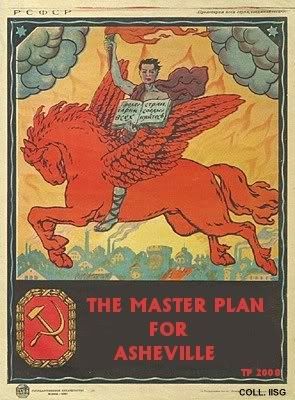
Asheville---Anyway You Like It, As Long As We Planned It.
From her newsletter...
Hear from local experts on the history of downtown. You'll hear why downtown developed the way it did, fell into disrepair and was ultimately revitalized. We'll also talk about segregation and urban redevelopment projects and the effects on downtown and local residents.
Thursday, May 15
7:00 pm
Asheville Public Works Building
161 S. Charlotte St.
Leslie Anderson - former Director of the Downtown Development office and expert on downtown revitalization
Jim Samsel - local architect and member of the Pack Square Conservancy
Harry Weiss - Public Interest Projects and former director of the Preservation Society
We hope to have an additional speaker to talk about the East End and downtown.
This evening promises to be full of interesting stories. Even if you know the general history of downtown, you will learn something new!
Source: Robin Cape Newsletter
The Master Plan for Asheville
The announcement and agenda:
Community Educational Session:
Current Issues in Downtown Development
Friday, May 30
6:00 - 8:00 pm
Asheville Community Theater
35 E. Walnut Street
This session will be an important opportunity to explore specific urban issues such as height & design, affordability and local business retention.
To put this effort into perspective, say that long ago, in a budding city far away...there was such a monstrously evil "Master Plan" for Manhattan. With the desire to impose height restrictions, design restrictions. Imposing a "mandate" to provide affordable housing, and here is the kicker...the very same people express a desire for local business retention when their plans drive away commerce!
Manhattan would not be as we know it today. There would be no skyscrapers in Manhattan. There would, in all likelihood, be skyscrapers around Manhattan, outside the reach of the Killers of the Free Market. And the same thing will happen to Asheville. It will drive out commerce of the sort that generates real wealth, inspire building of unique buildings in places other than Asheville (hopefully in the newly forming incorporating cities around Asheville).
This desire for "central planning" is straight out of the failed "command economies of the Socialist Soviet Union. It has been demonstrated to not work every time. The socialists on the Asheville City Council need to realize that the Free Market is far superior than their "Managed Utopia in Asheville, NC".
The normal people of Asheville, if there are any left, should get together and sabotage this Master Plan, and scuttle it to the dustbin of history. That is, if you want Asheville to be something other than the laughingstock of the region.
The Breck Girl Endorses Obama,
After The NC Primary !!!
The video:
Source: Mexitli's Blog "Columna de Aztlan"
Hat Tip: Betsy Muse, via BLUE NC
Commentary
Could John Edwards ever prove his indecision and utter uselessness any more?
Governor's 2008 - 2009 Proposed State Budget
Recommended budget adjustments for the 2008-2009 fiscal year will increase tax on cigarettes, beer, fortified wine and spirits.

May 14,
2008
NC NEWS -- Governor Easley has released his
recommended budget adjustments for the 2008-2009 fiscal year, which will
increase tax on cigarettes, beer, fortified wine and spirts. The proposed
budget will provide $12.5 billion for education including a 7% increase in
public school teachers pay. Currently, the difference between the US and North
Carolina average for a teacher with a bachelor's degree and 15 years experience
is 6.9 percent.
The budget proposal further improves the state's ability to
compete for jobs in the global economy, increases funding for mental health
services, and helps communities' better plan to deal with droughts. The
Governor also wants to expand funding for the oversight of prison parolees,
which means, "Operation FreeBird" is working.
The NC Governor also believes the budget better prepares the state
to deal with the uncertain economy by expanding the Rainy Day Fund to $848
million. Unlike most states that are facing shortfalls, North Carolina will end
the current fiscal year with a $152 million surplus. The budget also includes
$396 million in general fund budget cuts equaling nearly 2% of the total
operating budget.
Governor Easley said, "As I release the 2008-09 budget proposal,
the last one of my administration, I remain just as restless about improving
the lives of every North Carolinian. While we have made great progress in this
state, I am still not satisfied. We must build on our strengths to face the
challenges of the global economy and the best way we can do this is to expand
education at all levels."
Governor Easley's budget proposal includes a cigarette tax
increase, recommending a 20-cents-per-pack increase. The increase, which would
total 55 cents per pack, would keep North Carolina's cigarette tax among the
lowest in the nation, about 40th. Easley said, "It takes real revenue to make
real progress in education," therefore, once again singling out evil tobacco
smokers.
The budget recommends state employees receive the equivalent of
a 4 percent pay increase through a 1.5 percent cost-of-living adjustment and a
$1,000 one-time bonus. State employees will also receive five days of paid
bonus leave. The budget also includes a cost of living adjustment for state and
judicial system retirees.
The state mental health system will receive more than $76
million designated to implement changes in and improve services. The additional
costs will be offset by another tax increase on beer, fortified wine and
spirits.
More than $65 million is set aside for repairs to university and
state buildings along with another $97 million for pay-as-you-go finance of new
construction projects and borrowing for another 553 million in projects.
Highlighted recommendations in Easley's budget include:
PUBLIC SCHOOLS -- $492 million overall budget increase.
- $302.7 million to bring teacher pay to the national
average. - $90 million to fully funding the ABC bonuses for school
teachers. - $39.8 million to increase by 6,345 the number of More At Four
early childhood education program slots to bring enrollment to 35,000. - $12 million for increases in at-risk enrollment.
- $6.6 million to expand the Learn and Earn early college high
school program to continue operation of 55 schools and expand to an additional
16 schools in 2009-10. - $6 million to expand broadband high-speed connectivity for
public schools. - $2 million to assist those public schools with the greatest
needs.
COMMUNITY COLLEGES -- $58.3 million overall budget increase.
- $23.8 million for increased enrollment.
- $4.8 million for nurse accreditation programs and to add 55
allied health faculty positions to cut program waiting lists. - $5 million to address equipment needs, including health
programs. - $2.5 million to expand the NC Community College System Data
Warehouse. - $1 million to expand the Minority Male Mentoring initiative.
UNIVERSITY OF NORTH CAROLINA -- $107.5 million overall budget
increase.
- $34.6 million for increased enrollment.
- $11 million to implement the recommendations of the UNC
Campus Safety Task Force recommendations. - $2.5 million to implement American Bar Association
recommendations to accredit N.C. Central University Law School. - $2 million to support a new bioengineering facility and other
areas at NC State University's College of Engineering. - Expand EARN grants to accredited private NC colleges and
universities (can be done within existing budget).
HEALTH AND HUMAN SERVICES -- $217 million overall budget
increase.
- $20.9 million for community hospitals support short-term
stabilization in psychiatric inpatient services. - $6.8 million to support 30 mobile mental health crisis
teams. - $5.4 million to improve clinical staff ratios by adding 107
positions to provide closer patient supervision. - $5.5 million to address shortfalls in shift premiums and
worker compensation payments. - $5.2 million to support 36 beds at Dorthea Dix Hospital.
- $4.3 million for crisis intervention services for people who
have development disabilities by establishing nine regional START teams. - $4.2 million for walk-in crisis and psychiatric after
care. - $10 million to expand Health Choice to provide health care
for an additional 10,680 children from low income families. - $9 million to remove 1,110 children from subsidized child
care waiting lists and keep 931 children from being dropped. - $8.3 million to increase foster care and adoption assistance
payments.
JUSTICE AND PUBLIC SAFETY -- $49 million overall budget
increase.
- $22.6 million to restore funding for community programs that
reach out to delinquent and at-risk youth. - $9.1 million to restore funding for community-based programs
that aim at reducing recidivism and the costs of incarceration for the state
and counties. - $4 million to improve case management and supervision of
adult offenders on probation, parole and post-release. - $1.9 million to ensure female parolees and probationers have
access to residential substance abuse treatment services. - $600,000 so uninsured rape victims will no longer have to pay
a portion of the cost for forensic exams.
NATURAL AND ECONOMIC RESOURCES. -- $10 million for the One North
Carolina Fund to recruit new and expanding businesses.
- $5 million for the One North Carolina Small Business
Innovation Research Program to assist in capturing federal innovation research
grants. - $5 million for the Farmland Preservation Trust Fund.
- $4 million for the N.C. Biotechnology Center.
- $1 million to the N.C. Green Business Fund for grants to
small businesses to encourage growth of the green economy in the state. - $1 million to assist those facing foreclosure on their
homes. - $870,000 to establish a Drought Response Unit to aid
communities in preparing to withstand periodic droughts. - $720,000 to hire ten safety and health compliance officers in
the Occupational Safety and Health Division, positions that because of federal
funding cuts have been vacant. - $400,000 to clean up inactive hazardous waste sites.
- $141,330 for two food safety and security inspectors for the
meat and poultry industry.
TRANSPORTATION
- $28.8 million increase for highway maintenance
activities. - $25 million reduction in the Highway Trust Fund transfer to
the General Fund as the first step in phasing out the $172.6 million annual
transfer. These funds may be used for gap funding for N.C. Turnpike Authority
projects authorized by the legislature or urban loop project in the
Transportation Improvement Program.
SUPPORTING THE MILITARY
- $ 2.2 million to improve health and mental health services to
National Guard combat veterans and their families. - $1 million to support social service and morale programs on
North Carolina's military installations. - $1 million for college scholarships for children of National
Guard members killed or disabled while on active service duty. - $200,000 for Operation Kids On Guard to assist children of
deployed members of the N.C. National Guard.
CAPITAL IMPROVEMENTS – Financed Through Appropriations and
Certificates of Participation.
- $280.5 million for five University of North Carolina
projects that received planning funds previously including $97 million for the
new library on the N.C. State Centennial Campus; $62 million for the new School
of Dentistry at East Carolina University; $69 million for a new School of
Dentistry at UNC-Chapel Hill; $42.6 million for a new classroom building at
UNC-Greensboro and $9.8 million for the completion of a student activity center
at Winston-Salem State University - $14.5 million for a new classroom building at the Upper
Coastal Plains Higher Education Center. - $108.3 million for a women's health and mental health
medical facility in the Department of Corrections. - $63.1 million for additions to correctional facilities at
Scotland, Bertie, Lanesboro and Tabor. - $25.7 million to match federal and local funds for water
resource and sewer development projects. - $109.4 million for completion of the Green Square Complex in
Raleigh. - $5 million to be added to $10.2 million in receipts to
renovate a berth at the port in Wilmington and $2.5 million for berth
construction at the port in Morehead City. - $40.4 million for a new Capital Area Visitors Center and
parking deck in downtown Raleigh.
Finally, Governor Easley said, "This budget makes progress in
education, human services, public safety and economic development. I look
forward to working with the General Assembly to get this budget enacted before
June 30."
To read the complete NC Governor's recommended North Carolina State
Budget adjustments for 2008 through 2009 - Click Here.
Enroute to Berries
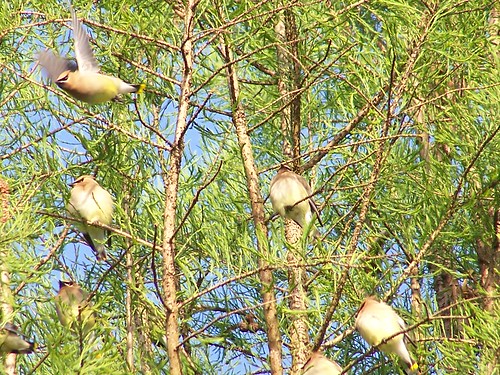
I posted a photo essay on Thunder Pig this morning of some Cedar Waxwings in a Dawn Redwood tree.
Campbell's Covered Bridge, and
A Maple in the Wind
Yesterday, I caught a Maple in the wind, and due to connectivity problems, am only now able to upload the video:
Got to Be NC Festival Scheduled!
May 11, 2008
WAKE COUNTY NC NEWS -- The premier "Got to Be NC" Festival is scheduled for June 5, 2008 through June 8, 2008! More than seventy-five North Carolina food service companies will showcase their products in the State Fairgrounds in the Exposition Building. The Got to be NC Agriculture Food Expo will be open on Friday from 4:00 to 9:00 p.m., and then from 10:00 a.m. to 6:00 p.m. on Saturday and Sunday. Among the festivities taking place in the Exposition Building, include daily live cooking demonstrations by local chefs and food enthusiasts, and booths with local artisans and other organizations promoting their products and services. Meanwhile, food vendors will be scattered across the fairgrounds for sampling and purchase of a variety of foods, from North Carolina barbecue to gourmet candy apples.
Other festivities at the Got to Be NC Festival includes fireworks, live music, draft horse pulls, a petting zoo, pig races, and antique tractor displays with more than 1,000 pieces of farm equipment. Another five star event, which will be held on Friday and Saturday, is the Official state barbecue cooking championship sponsored by the N.C. Pork Council. That means hopefully our friend, Mr. H. Page Skelton, Sr., will be cooking-up some delicious morsels smothered with his famous Cackalcky Spice sauce.
On Friday night in the Grandstand, draft horses will compete in a horse pull testing these equine specimens against the weight of a loaded sled. Additionally, the Got to Be NC Festival will have live music! A mixture of beach, country and bluegrass music will be performed by various players. With the Got to Be NC Festival hosting a bluegrass band competition in Heritage Circle!
Admission to the Got to Be NC Festival is free except for carnival rides and games, tractor pulls, and grandstand concerts. Gates open Thursday and Friday, 3:00 p.m. to midnight while on Saturday and Sunday, the festival will open from 10:00 a.m. to midnight. The State Fairground are easily located from I-40 at 1025 Blueridge road in Raleigh, NC.
Goodness Grows Director Jeff Jennings said, "There has been a lot of enthusiasm from our members and we are looking forward to a great show."
Agriculture Commissioner Steve Troxler announcing the Festival said, "The Food Expo will give festival attendees the chance to see, taste and buy many of the great products that we produce right here in North Carolina. This is a great opportunity for residents to become familiar with the great variety of North Carolina products so that they know what to look for the next time they go shopping."
Finally, all Companies participating in the Food Expo are members of the Goodness Grows in North Carolina Program, the official marketing program of the N.C. Department of Agriculture and Consumer Services. For more information contact: www.ncagfest.com
Ruminating on Fire Towers, Dreams, and Life
Check it out.
WNC Citizens Blog Partnering With County NC News
May 10, 2008
COUNTY NC NEWS -- In our never-ending effort to unite citizens of North Carolina, County NC News has partnered with West North Carolina (WNC) Citizens Blog to promote comment and discussion on news articles released in our magazine.
WNC Citizens Blog provides news, information and commentary on political events and encourages citizen activism in Western North Carolina. The Blog reports from a conservative perspective on the issues of the day, but also allows respectful debate.
From this point on, when this icon appears in a County NC News magazine article, it will signify the article is open for comment.

Additionally, blogging is a useful method for promoting civic interaction. We believe that this web partnership between WNC Citizens Blog and County NC News will benefit the state in numerous ways, two of most concerns follow.
First, citizens from across North Carolina will be able to share their thoughts on current news issues unifying our state in one common voice. Regardless whether you are liberal or conservative, your respectful comments and thoughts on issues affecting our state are welcome, obviously, making for good communicative interaction.
Next, living in an age of global technology, countries are now competitively pitted against one another for web presence, which has become an integral part of their prosperity as well as standard of living. Being that North Carolina is part of the United States, it is of utmost importance that North Carolinians contribute to this constant struggle for web presence to ensure that North Carolinians' prosperity is preserved for future generations. Therefore, County NC News and WNC Citizens Blog encourages you to support this partnership by sharing your comments on reported activities taking place in North Carolina.
Finally, we are grassroots news organization, for and by the people. We wish the best for our state and country. We believe in the self-evident truths postulated in the U.S. Constitution and enumerated by the U.S. Bill of Rights. We live by the rule of the North Carolina Constitution, which unifies us as one people and one state. This is our heritage and legacy, therefore, let's make the best of it, happy blogging!
Published by:
Rob Cross
mailto:editor@357news.com
# # #
Source: County NC News
Commentary
I have worked with Rob for over a year on an informal basis, and we have decided it is time to work together for all the reasons stated above, and expand both our web coverage of news and events in North Carolina for both our web sites. We have experimented with simultaneous coverage of events and news over the past few months, and will continue in that direction.
He can bring us on the ground coverage of events in the Northeastern part of the state, and we can give him the same from the Western part.
Stay tuned for more developments as we continue to build the network.
Letter from HK Edgerton:
An Open Answer for University of Wyoming Student
Dear Jacob,
While I have taken the field with re-enactors on several occasions, I don’t consider myself a re-enactor. I would direct you to my web site( www.southernheritage411.com ). I believe you will find answers to your questions there. I don’t understand your question about how I reconcile the connection between the Confederacy and the institution of slavery. The economic institution of slavery had many world wide players. However, when it comes to taking the blame for it, and it’s purported evils, it is only the Southland of America and the Christian White folks from the South that are laid to blame. It would be hard to disprove that in the body politic that during the epoch in which we speak that the standards for racial superiority set forth that the white man in the South was not superior to the Africans on this continent , but also because of his chivalrous nature towards his women, his manners, his religious ethics, and tenacity in combat; he probably was racially superior to most men on God’s earth. This does not mean that I am defending the economic institution of slavery . However, in an institution that the whole world was complicit in, Africans who were lucky enough to find themselves in the Southland of America were on a path of social vertical mobility unparalleled in the annals of mankind; only to have that journey derailed by greedy Northern protagonist who were jealous of the Southern wealth. These protagonist came from many circles; religion, industrialist, politicians and so forth.
It does not take a Rocket Scientist to understand or to prove that Abraham Lincoln was in the pocket of Northern industrialist , who were hell bent on building the infrastructure of the North and maintaining some semblance of industrial superiority . The criminal behavior of Lincoln and far too many of his soldiers have been swept under the carpet of history for too long. The old game of using the African people against the only man who ever cared about him or his well being ; the Southern White man is an old ploy . It is one that has been taught well since the establishment of the public school system in the South in 1865. I can only hope that your studies at the University of Wyoming will lead you to a more truthful understanding of why an honorable people went to war against their brother who invaded their homeland and on more than one occasion almost bankrupted it . Furthermore, I hope that you can come to understand that right down here in the South, a love was formed between a man called Master and a man called slave. It is unfortunate that there are those who continue with their Reconstruction modus operandi to destroy that love .
HK Edgerton
As always, you can visit Southern Heritage 411 to find out more on this subject, and help H.K. educate people learn the truth of our shared heritage.
A Note of Thank You From Carl Mumpower
A Note of Thank You
There is a Vietnamese proverb that speaks to yesterday's primary - " When eating a fruit, think of the person who planted the tree."
I wanted to drop a note of thanks to the many people who laid their special touch on yesterday's success. I know that there were many thoughts, prayers, and actions that went unnoticed - all mattered in the outcome.
We won with limited dollars and a willingness to hold hard to principles as we pushed away from the political power structure. It worked - sometimes in spite of my best efforts. That means something, because we not only won, but we also won right. Therein is a foundation for independent public service with opportunities to shake things up and redefine the model.
With your help we have cleared the first hurdle. We have a strong foundation for the next steps. In short order we will begin an aggressive campaign that will take full advantage of the time, challenges and opportunities between now and November. Your help will be no less important tomorrow that it was yesterday.
A good place to start? We need to hold as many "meet and greets" throughout WNC as possible over the next few months. If you can get a group together, I will bring my stool and portable microphone and we will have a face to face real world question and answer session that I promise will have your friends, church members, neighbors, and others saying, "This man is approaching public service in a new way - he is genuine in his commitment to principle over politics, party, power, or popularity - I want to help".
Again, please accept my thanks. We did not win a prize last night - we assumed a responsibility - a responsibility that I intend, with your good help, to embrace with a full heart. I am reminded of words of wisdom from Shakespeare on gratitude that seem very real today, "How far that little candle throws his beams! So shines a good deed in a weary world."
89
Campaign Website
Subscribe to Mumpower Express
Macon County Primary Results
Local Race First...
COUNTY COMMISSIONER DISTRICT III
(GOP)
53.28% 1,363 Jimmy Goodman
46.72% 1,195 Charlie Leatherman
Now, the other stuff, of which Macon County was only a part of the total:
PRESIDENT
(DEM)
66.57% 3,533 Hillary Clinton
30.47% 1,617 Barack Obama
(GOP)
71.88% 1,943 John McCain
14.76% 399 Mike Huckabee
08.66% 234 Ron Paul
03.22% 87 No Preference
US SENATE
(DEM)
44.17% 1,826 Kay Hagan
33.12% 1,369 Jim Neal
(GOP)
89.56% 2,384 Elizabeth Dole
10.44% 278 Pete Di Lauro
US CONGRESSIONAL DISTRICT 11
(GOP)
43.29% 1,038 Carl Mumpower
38.53% 924 Spence Campbell
18.18% 436 John Armor
GOVERNOR
(DEM)
49.99% 2,326 Bev Perdue
47.00% 2,278 Richard Moore
(GOP)
50.88% 1,272 Fred Smith
18.96% 474 Bill Graham
14.92% 373 Pat McCrory
11.92% 298 Bob Orr
03.32% 83 Elbie Powers
LIEUTENANT GOVERNOR
(DEM)
41.42% 1,788 Walter Dalton
33.73% 1,456 Pat Smathers
(GOP)
52.17% 1,176 Bob Pittenger
24.22% 546 Jim Snyder
16.19% 365 Tim Cook
07.41% 167 Greg Dority
NC STATE HOUSE DISTRICT 119
(DEM)
81.68% 896 Phil Haire
18.32% 201 Bruce Friedman
Commentary
MACON COMMISSION RACE
In the local county commission race, I think the thing that killed Leatherman was his support for building moratoriums, height restrictions, and the HUGE Bond Referendum that threatened to put an onerous burden of debt on future generations of Macon county. That Bond Referendum, and certain Commissioner attitudes about that will be an issue in the General Election locally.
US PRESIDENTIAL RACE
I cannot help but notice that there was a significant protest vote yesterday. 26% voted AGAINST the presumptive nominee. The Ron Paul Supporters might have been able to make something out of that if they had used honey instead of vinegar in their campaign efforts.
US CONGRESSIONAL RACE
The Mumpower Campaign ran a very efficient operation. I thought that they had shot themselves in the foot on FISA, my major policy disagreement with the candidate.
STATS, STATS, AND MORE STATS
The North Carolina State Board of Elections finally joined the Internet Age with their very prompt posting of results. This, of course, was due to the state being in the National Spotlight because of the Democrat Presidential Contest. I just hope they continue providing this level of statistics...which promises to keep me very busy over the next few weeks as I digest the information.
Mumpower Video Diary
NC Primary: Winners, Losers, and Protesters
President (DEM)
| Percent | Votes | ||
|---|---|---|---|
| Hillary Clinton (DEM) |  | 42.85% | 540,775 |
| Mike Gravel (DEM) | | 0.80% | 10,036 |
| Barack Obama (DEM) | | 54.89% | 692,822 |
| No Preference (DEM) | | 1.47% | 18,512 |
| 1,262,145 |
President (GOP)
| Mike Huckabee (REP) | | 12.27% | 52,802 |
| Alan Keyes (REP) | | 2.51% | 10,793 |
| John McCain (REP) | | 74.03% | 318,513 |
| Ron Paul (REP) | | 7.27% | 31,298 |
| No Preference (REP) | | 3.91% | 16,818 |
| 430,224 |
Do you hear us, McQeeg?
US HOUSE NC-10 (GOP)
| Patrick McHenry (REP) | | 65.88% | 29,408 |
| Lance Sigmon (REP) | | 34.12% | 15,232 |
| 44,640 |
Ha Ha! Fake candidate, and tool of progressives everywhere, Lance Sigmon is soundly whipped by McHenry.
US HOUSE NC-11 (GOP)
| Spence Campbell (REP) | | 41.48% | 15,616 |
| Carl Mumpower (REP) | | 49.00% | 18,447 |
| John C. Armor (REP) | | 9.52% | 3,586 |
| 37,649 |
Wow! I thought for sure Campbell had bought this race. Now, let's see if Shuler can be coaxed to have a dozen or so debates across the district...
NC GOV (DEM)
| Richard H. Moore (DEM) | | 40.55% | 484,048 |
| Dennis Nielsen (DEM) | | 4.03% | 48,125 |
| Bev Perdue (DEM) | | 55.42% | 661,479 |
| 1,193,652 |
NC GOV (GOP)
| Bill Graham | | 9.24% | 38,870 |
| Pat McCrory | | 45.36% | 190,816 |
| Bob Orr | | 6.81% | 28,660 |
| E. Powers | | 0.85% | 3,582 |
| Fred Smith | | 37.73% | 158,717 |
| 420,645 |
I can't tell you how disappointed I am in this race. Smith and Orr split the conservative vote, and let a RINO waltz through. Moonbat McCrory...crap, crap, crap!!!
And in local races for Buncombe County Commissioner:
DEMOCRATS
21.45% Holly Jones
14.94% K. Ray Bailey
13.81% Carol Peterson
12.29% Bill Stanley
REPUBLICANS
24.07% Joe Dunn
19.79% John Carroll
17.36% Don Yelton
16.29% Ron McKee
Good Night...I've had all I can take.
NC Primary Results Live-Blog
President GOP and DEM (I want to measure the GOP Protest vote)
NC-11 GOP Primary
NC Gov GOP and DEM (I want to show that having multiple conservatives in a primary only hurts the conservatives, and helps the RINOs...I am designating McCrory as a RINO.)
I'll post state-wide results, and focus on the NC-11 Counties in more detail.
I'll post the updates in the comments, and have a running total in this post so you won't have to dig through a zillion entries.
Cumulative Numbers
-----------------------
PRESIDENT
DEM
Clinton
Obama
GOP
McCain
Paul
-------------------------
US HOUSE NC-11 GOP
Spencer
Mumpower
Armor
---------------
NC GOV
DEM
Perdue
Moore
GOP
Smith
McCrory
Orr
Graham
There are other races I wish to track, but I think this is all I can handle while blogging.
**8.33pm looks like McHenry is safe in NC-10!
-------------------------
PRESIDENT
DEM
Clinton 42.17%
Obama 55.75%
GOP
McCain 74.08%
Huckabee 12.10%
Paul 7.40%
No Pref 3.91%
-------------------------
US HOUSE NC-11 GOP
Spencer 39.90%
Mumpower 50.54%
Armor 9.56%
-------------------------
NC GOV
DEM
Perdue 55.69%
Moore 40.52%
GOP
Smith 36.86%
McCrory 46.55%
Orr 6.74%
Graham 9.02%
Primary Day Slide Show
Poll workers reported turnout was either even with past Presidential Primaries, or ahead...sometimes as much as 50% greater (or in the ball park), with most of the increase coming from early voting.
Here is a brief slide show of some of the images I took, and I may have video collection of people I gave a chance to campaign on video for their candidate sometime tomorrow:
Primary Day Report: Savannah Precinct in Jackson County
Here are a few photos I snapped:
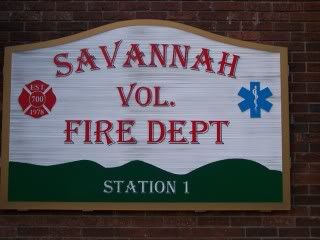
Polling Place
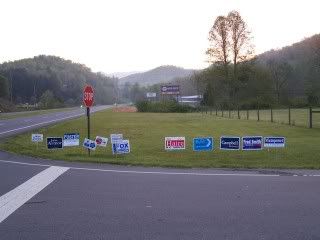
Candidate Corner
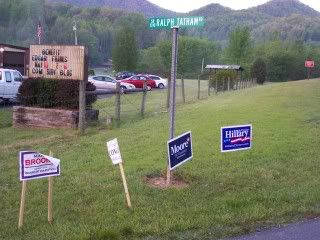
Signs and Cars
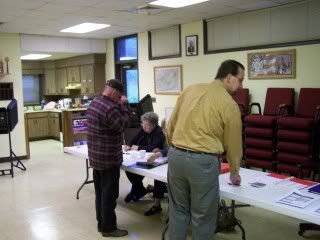
Voters
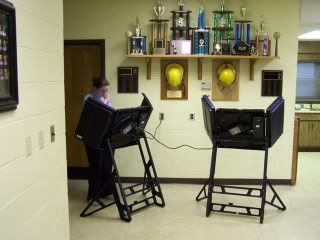
Decision Time

Bradford Pears at Dawn
Weightless